
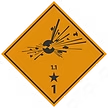
Explosives in this group can undergo a mass explosion, meaning the entire load can explode almost all at once.
These explosives are capable of throwing out fragments or causing dangerous projections, but they aren’t likely to explode all at once.
Similar to 1.2, these can create projection hazards (pieces being thrown), but they don’t present a mass‑explosion risk.
These present only a minor explosion risk. If they do react, the effects are mostly limited to the package itself you shouldn’t expect large fragments or long‑range projection. Also, an external fire shouldn’t cause the whole package to detonate almost instantly.
This group contains very insensitive explosives that could produce a mass explosion in theory, but they’re designed so that ignition or transition from burning to detonation is highly unlikely during normal transport.
These are extremely insensitive items that do not pose a mass‑explosion hazard. They contain materials so unlikely to detonate accidentally that the chance of initiation or propagation is negligible.
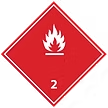
This includes gases that are highly flammable under normal conditions. Specifically, it’s any gas (weighing 454 kg or more) that:
Is a gas at room temperature (20°C / 68°F) and standard pressure,
and either
Can catch fire when mixed with air at concentrations of 13% or less, or
Has a wide flammable range (at least 12% when mixed with air), even if the concentration needed to ignite it is higher.
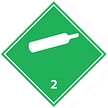
This group covers gases that are not flammable or poisonous but are still pressurized or hazardous in other ways. It includes:
Compressed gases
Liquefied gases
Cryogenic (extremely cold) gases
Gases dissolved under pressure
Gases that can displace oxygen (asphyxiants) or support combustion (oxidizers)
To qualify, the gas must:
Have a pressure of at least 280 kPa (40.6 psi) at room temperature (20°C),
And not meet the criteria for being flammable (Subclass 2.1) or poisonous (Subclass 2.3).
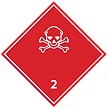
These are toxic gases that can be harmful or even deadly when inhaled. To fall into this category, a gas must:
Be a gas at 20°C and 101.3 kPa,
and either
Be known to be dangerous to human health during transport, or
Be assumed toxic based on tests in lab animals, where exposure levels (LC50) are 5000 ml/m³ or lower.
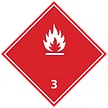
A flammable liquid is any liquid with a flash point (the lowest temperature at which it can give off enough vapor to ignite) of 60.5°C (141°F) or lower.
It also includes any liquid with a flash point of 37.8°C (100°F) or higher if:
It is intentionally heated, and
It’s transported at or above its flash point in bulk packaging.
Gases or compressed gases – Any liquid that qualifies as a gas under the definitions in 49 CFR 173.115 (like flammable or non-flammable gases).
Diluted mixtures – Mixtures where 99% or more of the volume is made up of components with flash points above 60.5°C (141°F), as long as they’re not transported at or above their flash point.
Liquids that don’t sustain combustion – Liquids with a flash point above 35°C (95°F) that don’t keep burning during standard fire tests (like ASTM D4206 or Appendix H procedures).
High fire point liquids – Liquids with a flash point above 35°C (95°F) and a fire point (temperature at which they keep burning) of over 100°C (212°F) according to ISO 2592.
Highly water-based solutions – Liquids with a flash point above 35°C (95°F) that are more than 90% water by mass and fully mix with water.

Flammable solids include materials that are easily ignited and can cause fire through friction (like matches), or are reactive and self-reactive under transport conditions. Some may also become explosive when dry or during transport.
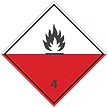
These are materials that can catch fire on their own when exposed to air, without needing a spark or flame.
There are two types:
Pyrophoric materials – ignite within 5 minutes of air exposure.
Self-heating materials – slowly heat up on their own and can eventually ignite when exposed to air over time, even without any external heat source.

These materials react dangerously with water. When wet, they can:
Catch fire spontaneously, or
Release flammable or toxic gas at a rate higher than 1 liter per kilogram per hour.
Even small spills or moisture can create serious risks.

Oxidizers are materials that can supply oxygen (or otherwise help) and so make fires burn hotter or start more easily.
How solids are classified: A solid is an oxidizer if, using the UN test methods, it burns at least as fast as a reference mixture made from potassium bromate and cellulose (3:7). If its average burning time is equal to or shorter than that reference, it’s a Division 5.1 material.
How liquids are classified: A liquid is an oxidizer if, under the UN tests, it either ignites on its own or causes pressure inside a closed test vessel to rise from 690 kPa to 2070 kPa in less time than a reference 1:1 mixture of 65% nitric acid and cellulose.
In short: if the substance noticeably speeds up combustion in the standard tests, it’s an oxidizer.
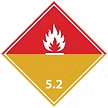
Organic peroxides are organic chemicals that contain the distinctive peroxide linkage -O–O- (they’re chemically related to hydrogen peroxide). Many are energetic — they burn quickly and can be sensitive to heat, shock, or friction — so they’re handled as a distinct hazard class.
They are treated as Division 5.2 unless one of the following applies:
It’s actually an explosive. If the material meets the legal definition of an explosive, it must be classified as an explosive instead of a peroxide.
Transportation is already forbidden. If other rules (e.g., specific DOT listings) prohibit offering it for transport, it’s not classed here because it’s not shippable.
Regulatory determination. The relevant authority (Associate Administrator for Hazardous Materials Safety) may decide a material does not present the hazards associated with Division 5.2 — in that case it’s not treated as a peroxide.
Concentration / available oxygen limits. Some low‑concentration peroxide formulations are exempt. For example:
If a material contains no more than 1.0% hydrogen peroxide and its calculated available oxygen (using the regulatory equation) is ≤ 1.0%, it’s not considered a Division 5.2 material.
The text you provided cuts off mid‑clause after “more than 1.0 percent but not more than 7.0 percent hydrogen peroxide.” Generally, regulations then set additional limits and packaging/labeling requirements for materials in that intermediate concentration range (rather than automatic Division 5.2 classification).
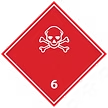
These are materials that are dangerous to human health if inhaled, swallowed, or absorbed through the skin. They can cause injury or death during transport.
Some are known to be toxic to humans.
Others are presumed toxic based on animal testing that shows harmful effects.
Includes irritants like tear gas, which can cause intense discomfort, especially in small or enclosed spaces.
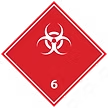
These are substances that contain or are reasonably expected to contain pathogens — micro-organisms (like bacteria, viruses, fungi, parasites, prions) that can cause disease in humans or animals.
Infectious Substances – Known or suspected to contain disease-causing agents (e.g., blood samples containing viruses).
Biological Products – Vaccines, therapeutic products, or materials for diagnosis or research, made from living organisms.
Cultures – Pathogens grown in labs. These are typically more hazardous than patient samples.
Patient Specimens – Samples from people or animals (e.g., blood, urine, tissue) taken for testing or diagnosis.
Medical or Clinical Waste – Waste generated from medical care or research that may contain infectious substances.
These are high-risk infectious substances that can cause severe, life-threatening, or fatal diseases in healthy humans or animals if exposed.
Must be assigned to:
UN2814 – if it affects humans (e.g., Ebola, HIV cultures).
UN2900 – if it only affects animals (e.g., Foot-and-mouth disease).
Cultures of known dangerous organisms (like Anthrax, Rabies, or Yersinia pestis) fall here.
If you’re not sure, it must be treated as Category A.
These are less dangerous infectious substances — they may cause illness but are not typically life-threatening in healthy individuals.
Must be assigned to:
UN3373
Proper shipping name: Biological substance, Category B
Some materials are exempt from regulation if:
They don’t contain infectious substances or have non-pathogenic microbes.
Pathogens have been inactivated or neutralized.
They are environmental samples (e.g., soil, food, water) not posing infection risks.
They are dried blood spots or blood components for transfusions or transplants.
Patient specimens with a minimal likelihood of pathogens — if properly packaged and labeled “Exempt human specimen” or “Exempt animal specimen”.
Must include:
Leak-proof primary container
Leak-proof secondary container
Strong outer container (at least 100mm x 100mm surface)
Absorbent material between containers (for liquids)
Professional judgment (based on symptoms, history, or local disease risks) is needed to determine whether a sample qualifies for exemption.
If packaged under licensed authority and used for healthcare, they are not regulated.
If they may contain pathogens, they are classified like infectious substances (UN2814, UN2900, or UN3373).
If not infectious, classified separately (not as Class 6.2).
If it contains Category A pathogens → UN2814 or UN2900
If it contains Category B pathogens or low risk → UN3291
Cannot be shipped by air unless absolutely necessary. Special government approval is required.
Animal carcasses infected with Category A or B pathogens must be handled under UN2814, UN2900, or as determined by authorities.
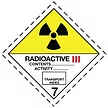
These are materials that are harmful to people. Some are confirmed to be toxic through testing, while others are assumed to be dangerous based on how animals react to them. They can pose serious health risks during transport, especially if spilled or inhaled.
Radioactive materials give off energy that can be harmful to people and the environment. They require special handling and labeling during transportation to keep everyone safe.
Some radioactive materials are shipped in packages with high-risk labels. Even if labels are missing, certain shipments still require visible warnings on the transport vehicle.
Vehicles carrying radioactive materials must be enclosed and secured so that no one can access the cargo space without permission. These enclosures can be either permanent or temporary, but must completely cover the cargo from top, sides, and bottom.
This is the part of the package that’s built to keep the radioactive contents safely inside during the trip.
Transport can happen in different ways:
On land, using a truck or train.
On water, using a ship or a container on the ship.
By air, using an airplane.
Each radioactive package or shipment must be fully described with details like drawings, documents, and test results to prove it meets safety rules.
Sometimes, one sender uses a vehicle just for their radioactive shipment. This means the sender controls all loading and unloading and provides written instructions to ensure safety. Only trained workers are allowed to handle these shipments.
These are types of radioactive elements like plutonium or uranium that can cause nuclear reactions. Some forms, like natural or depleted uranium, are not considered dangerous in this way and are treated differently.
When radioactive materials are especially strong or packed in large amounts, they are considered high-risk and must follow extra safety steps.
Reusable shipping containers are used to move multiple packages at once. If they’re big enough or meet certain size rules, they’re treated as large containers and must meet extra requirements.
Very large amounts of radioactive materials must only be transported on approved routes. These amounts are based on how dangerous the material is, and strict limits are applied to keep transport safe.
Some radioactive materials are shipped in very small amounts. These are still controlled but are treated less strictly, as long as they stay under specific limits.
Some radioactive materials give off only a small amount of radiation. These are still packaged safely, but because the danger is lower, the rules around them are slightly more flexible. The radiation level is measured without considering any shielding the material might be packed with.
Corrosive materials are liquids or solids that can destroy human skin completely if they come into contact with it for a certain amount of time. Some liquids are also considered corrosive if they can badly damage metals like steel or aluminum.
Sometimes, real-life experience or additional data shows that a substance is more or less dangerous than expected based on standard tests. If that happens, the authorities can change how the substance is classified or decide it doesn’t need to follow the usual rules.
Test results done before October 1995, using the older approved methods, can still be used to help determine how dangerous a corrosive substance is to skin, and how it should be packaged.
When shipping large amounts (over 454 kg or 1001 lbs) of corrosive materials, safety is critical. Even though both acids and bases fall under corrosives, official guidelines don’t specifically require separating incompatible types. However, you should always keep them apart. Mixing certain corrosives can cause violent chemical reactions.
In the event of a transportation accident, especially one involving a mix of corrosives, responders should use extreme caution.

This category includes substances that pose a risk during transportation but don’t fall under any specific hazard class. It generally covers:
Materials with anesthetic, noxious, or irritating properties that could seriously disrupt a flight crew’s ability to safely perform their duties due to extreme discomfort or distraction.
Materials classified as elevated temperature substances, hazardous wastes, hazardous substances, or marine pollutants.